Cat Body Language Cheat Sheet: Signals, Tails, Meows
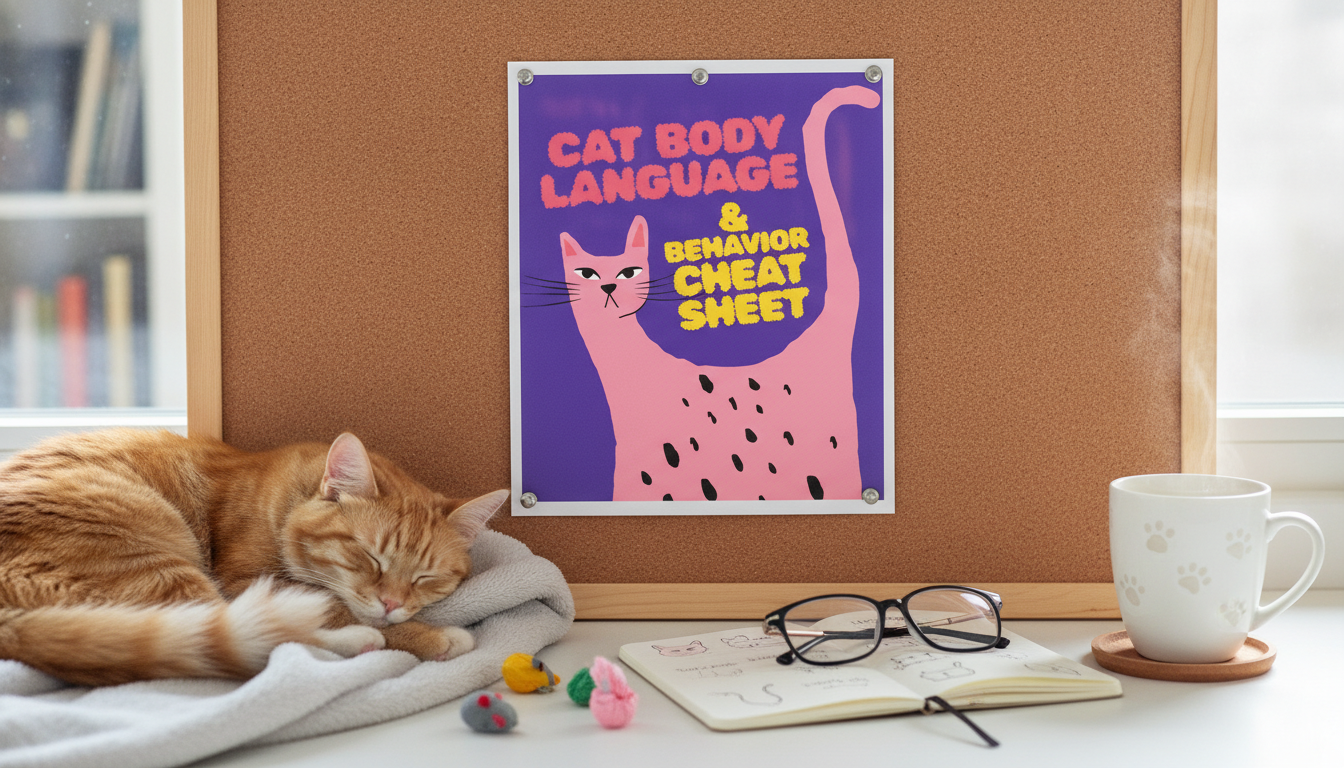
Cat Body Language & Behavior Cheat Sheet: A Printable Guide to Signals, Postures, and Meows
Cats communicate with their whole body—often in subtle combinations that are easy to miss in the moment. A quick-reference printable can help translate posture, tail, ears, eyes, whiskers, and vocalizations into practical next steps, whether the goal is calmer handling, better play, or avoiding accidental stress triggers.
How cats communicate: the “whole picture” rule
One signal rarely tells the full story. Cats stack body cues together, and those clusters are what make their message clear.
- Look for clusters (tail + ears + body tension + distance) rather than a single cue.
- Context changes meaning: a puffed tail during rough play can resemble fear—check the rest of the body and what just happened.
- Distance matters: many cats say “please give space” long before hissing or swatting.
- If signals conflict (purring but stiff posture), prioritize safety: reduce pressure and give the cat a choice to disengage.
Body posture and movement: relaxed, alert, fearful, or defensive
Posture is the headline of cat communication. Movement quality—smooth vs. frozen, loose vs. tense—often predicts what happens next.
- Relaxed: loose muscles, weight evenly distributed, smooth movements. Often approachable if the cat also chooses to come closer.
- Curious/alert: forward lean, stillness, ears forward, eyes focused. Offer choice-based interaction and let the cat close the distance.
- Fearful: crouched low, weight shifted back, ready to bolt. Lower noise, avoid reaching overhead, and provide an easy escape route.
- Defensive: arched back, sideways stance, raised fur. Increase distance, remove stressors, and never corner.
- Offensive/agitated: stiff legs, forward body, hard stare. Pause, give space, and reset the environment (quiet, routine, predictable).
Tail signals: speed, height, and shape
The tail is a fast-moving “status bar” for arousal. Height often shows confidence, while speed and force often show rising intensity.
- Tail up with a relaxed tip: friendly greeting. Allow a sniff and gentle, brief petting if the cat solicits.
- Tail tucked: anxiety or uncertainty. Slow down, keep hands low, and let the cat decide.
- Puffed tail: high arousal (fear, surprise, or intense play). Stop advancing and lower stimulation.
- Fast thrashing/lashing: irritation. End petting or play and give space before it escalates.
- Slow swish: focused attention (often hunting/play). Use a toy to channel energy rather than hands.
Quick tail guide
| Tail cue | What it often means | What to do next |
|---|---|---|
| Tail held high, soft curve | Comfort and confidence | Let the cat initiate contact; reward calm behavior |
| Tip twitching while sitting | Mild arousal or indecision | Pause interaction; offer a toy or treat toss |
| Lashing side to side | Overstimulation/annoyance | Stop touching; give space and a quiet reset |
| Tucked close to body | Fear or discomfort | Reduce stressors; provide hiding spot/escape route |
| Puffed tail + sideways body | Defensive warning | Back away; avoid eye contact; do not corner |
Ears, eyes, and whiskers: the “face dashboard”
Facial signals shift quickly. Watch the ears first, then confirm with eyes and whiskers.
- Ears forward: engaged/curious—often a good time for play or treat-based training.
- Ears sideways (“airplane ears”): uneasy or conflicted—lower intensity and add distance.
- Ears flattened back: high stress or defensive aggression—stop interaction immediately.
- Slow blink: friendly, non-threatening—respond with a slow blink and relaxed shoulders.
- Dilated pupils: can signal fear, excitement, pain, or low light—check the environment and the rest of the body.
- Whiskers forward: interest (often hunting/play). Whiskers pinned back: tension or discomfort.
Meows, purrs, and other sounds: what they can (and can’t) tell you
Cat vocalizations are real communication, but they’re easiest to interpret when paired with body language and routine patterns.
- Meowing is often directed at humans: patterns matter more than a single sound (before meals, at doors, at night).
- Short meow: greeting or request—respond with a consistent routine if appropriate.
- Repeated loud meows/yowls: stress, frustration, mating behavior (if not spayed/neutered), or potential medical issues—note frequency and triggers.
- Purring: often comfort, but sometimes self-soothing during pain or anxiety—confirm with relaxed posture and normal behavior.
- Growl/hiss/spit: clear “increase distance”—stop handling and remove conflict triggers.
- Chirps/trills: friendly excitement—often a greeting or “follow me” sound.
Common scenarios and what to do in the moment
Using a printable cheat sheet for faster, calmer handling
Printable Cat Communication Guide: what’s included and who it helps
For a ready-to-print reference, see the Printable Cat Body Language & Behavior Cheat Sheet. For families practicing calm, respectful interactions across the board, the Talk & Connect: Parent-Child Communication Workbook can help reinforce gentle boundaries and “ask-first” habits. If stress runs high during transitions (new home, vet prep, introductions), Calm Your Mind: Guided Meditation Series can support a steadier routine—cats often respond to calmer human energy.
For deeper feline-friendly handling and behavior guidance, reputable resources include the American Association of Feline Practitioners (AAFP) Cat Friendly resources, the Cornell Feline Health Center, and International Cat Care.
FAQ
Why does a cat purr while acting tense or hiding?
Purring can mean comfort, but it can also be a self-soothing behavior when a cat is anxious or in pain. Check posture, appetite, grooming, and whether the behavior is new; if tension or hiding is sudden or paired with other changes, schedule a veterinary visit.
What does it mean when a cat’s tail is wagging like a dog’s?
In cats, tail lashing more often signals irritation or overstimulation than friendliness. Stop petting or close-up play, give space, and redirect energy with a toy that keeps hands at a distance.
How can kids tell when a cat wants to be left alone?
Simple cues include ears back, a lashing tail, crouching, moving away, or growling/hissing. A good rule is “look, don’t touch” until the cat approaches, and use toys or treat tosses instead of grabbing or hugging.









Leave a comment